South Korea Passport 2026
South Korea Passport photo requirements: 3.5 × 4.5cm, white background, head height 3.2-3.6cm.
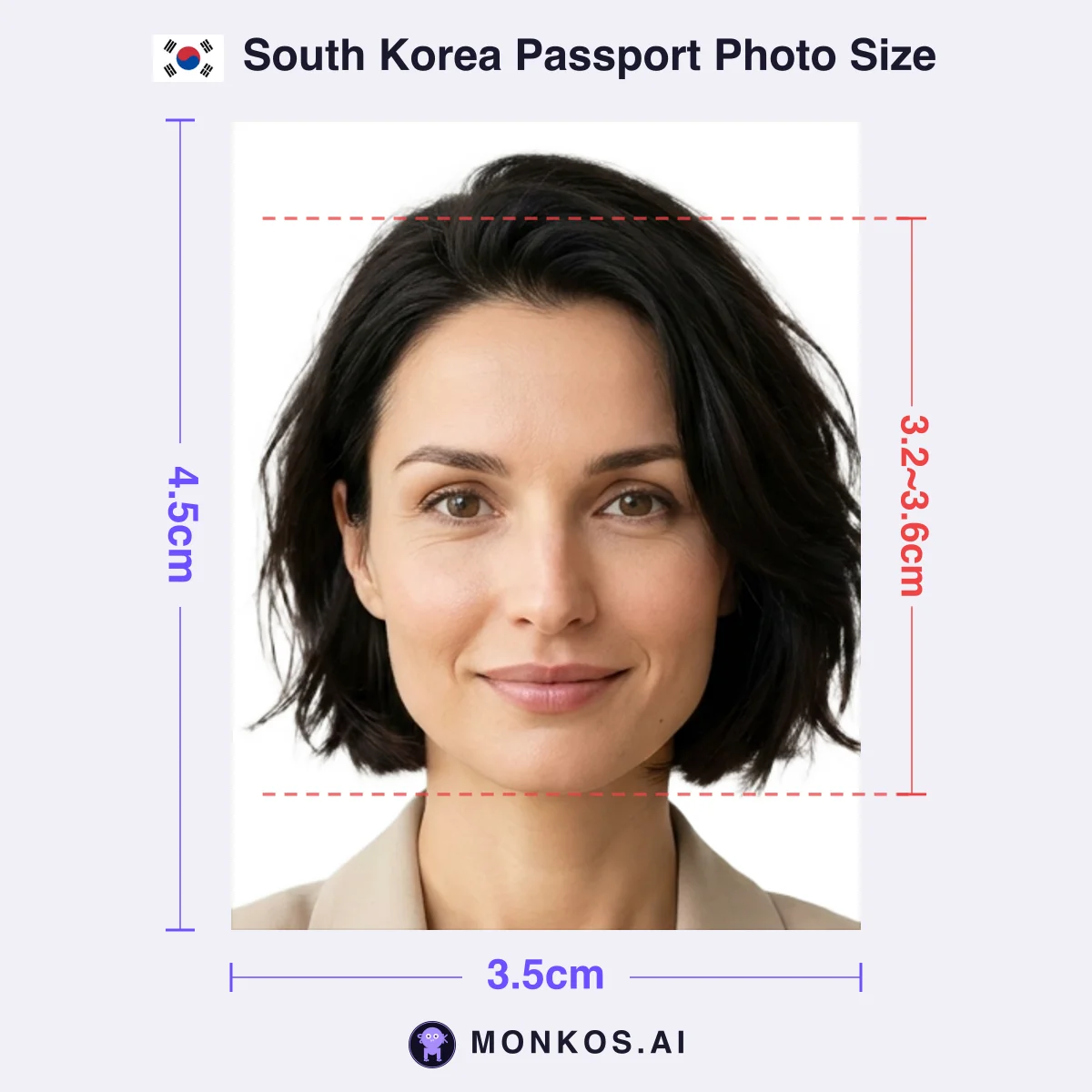
| Size | 3.5 × 4.5cm |
|---|---|
| Resolution | 413 × 531px |
| DPI | 300 or higher |
| Background | White |
| Head Height | 3.2-3.6cmRequired |
| Validity | Taken within 6 months |
| File Spec | JPEG, under 500KB, 300DPI+ |
- Taken within the last 6 months, upper body facing the camera
- Uniform white background with no shadows, patterns, or borders
- Mouth closed, neutral expression — visible teeth cause rejection
- If wearing glasses, no glare or thick frames covering the eyes (no glasses recommended for driver licenses)
- Hair and accessories must not cover the outline of the face
- Color photo with natural skin tone · no excessive retouching
Restrictions
- Clothing
- neck covering acceptable if face outline exposed; no scarves covering facial contours
- Expression
- natural neutral expression, closed mouth, no teeth showing, eyes open looking straight ahead
- Glasses
- regular glasses permitted if frames do not obscure eyes and no glare; no sunglasses, tinted, colored, cosmetic, or blue-light lenses
- Ears
- Ears may be covered — the ear-visibility rule was abolished in 2018 (MOFA); hair must still not cover the eyebrows or facial contours
- Face
- hair cannot cover eyes, eyebrows, or facial contours (cheekbones, jawline); forehead to chin must be fully visible
- Headwear
- no hats, headbands, or hair accessories; religious headwear permitted if worn daily and full face visible (forehead to chin)
- Accessories
- no jewelry causing light reflection or obscuring face; no earphones or wireless earbuds
- Background shadowsShadows in front of or behind the face
- Head height out of rangeCrown-to-chin outside the 32-36mm range
- Expression / smileOpen mouth or visible teeth
- Glasses glare / colored lensesLight reflecting on lenses or tinted contacts
- Face covered by hair or accessoriesForehead, eyebrows, or ears obscured
Documents Accepting the Same Photo
7
"Your Ears Must Show" Was Abolished in 2018
South Korea abolished the rule requiring both ears to be visible in passport photos on January 25, 2018, so hair covering the ears is no longer grounds for rejection as long as the eyebrows and facial contours remain visible.
On January 25, 2018, Korea's Ministry of Foreign Affairs relaxed its passport photo rules to align with ICAO standards. Alongside the two-ear exposure requirement, the ministry also scrapped the requirement to keep shoulders level, the advisory against thick-rimmed glasses, the ban on uniforms and military dress, and the advisories against wigs and jewelry. Wearing thick-rimmed glasses or a uniform in your photo is no longer a violation. One caveat remains: earrings or piercings that reflect light or obscure the facial contours are still disallowed under the current rules.
There is one twist worth knowing. The 2018 relaxation also dropped the eyebrow-coverage item, but the current rules (revised October 2022) once again explicitly prohibit photos where hair covers the eyebrows or facial contours such as cheekbones. Under today's standard, covered ears are fine — covered eyebrows are not.
Many photo studios and older blog posts still repeat the abolished rules, telling applicants their ears must show or that thick frames are banned. The only reliable reference is the current specification page on the Ministry of Foreign Affairs passport portal.
What Actually Gets Photos Rejected — Colored Lenses, Bangs, AI Retouching
Under Korea's current passport photo rules, the rejection risks that can slip past automated checks are colored or circle contact lenses, bangs covering the eyebrows or facial contours, and retouched images — including AI-edited photos, which the Ministry of Foreign Affairs explicitly disallows.
The current MOFA rules state that cosmetic, colored, and circle contact lenses, tinted glasses, and sunglasses may not be worn. Lens use is exactly the kind of flaw automated photo checkers struggle to detect, which makes it a classic case of a photo passing online pre-verification and then being rejected at the counter. Regular glasses are permitted as long as there is no glare and the frames do not cover the eyes.
Bangs are the same story. The rules prohibit not only hair over the eyes but any photo where hair covers the eyebrows or the facial contours such as cheekbones — the entire face from forehead to chin must be visible. A photo framed on the assumption that only the eyes need to show can still be refused.
The retouching rules were tightened in the October 2022 revision. Photos altered with editing software or filters are disallowed, and the rules now explicitly extend to AI-based edits, composites, and generated images. Photos with the background erased in Photoshop or the subject pasted onto a white background are also rejected, and Korea's Government24 online application repeats the AI-editing ban on its upload screen.
MOFA offers an online photo pre-verification service, but it warns that even a photo that passes verification can still be rejected during review at the application office. Treat the automated check as a reference, not a guarantee — the final call is made by a human examiner. The intent of the rule is to block edits that distort identity; in practice, what draws rejections is retouching heavy enough to change how the face reads, with the final call made by the examiner comparing the photo against you in person.
Online Renewal via Government24 — The Digital File Has Its Own Spec
Korea's online passport renewal on Government24 only accepts a JPG/JPEG file of 500KB or less, ideally 413 × 531 pixels and strictly within 395–431 pixels wide by 507–550 pixels tall, and only citizens who have previously held a Korean electronic passport can apply online.
Online renewal is judged on a digital file, not a printed photo. The Ministry of Foreign Affairs specifies JPG/JPEG format, a 500KB maximum, and 300dpi recommended; 413 × 531 pixels is the recommended size, and files outside the 395–431 × 507–550 pixel window cannot be uploaded at all. A photo straight off a smartphone is far larger than this window, so resizing to spec comes first.
Eligibility is also restricted. Online renewal is open only to Korean citizens who have previously been issued an electronic passport; first-time applicants and anyone needing a romanized-name change or a correction to their resident registration details must apply in person. Pickup also requires a personal visit to the passport office (a legal guardian may collect on behalf of a child under 18), so the process is not fully remote.
Before uploading, you can pre-check the file with the online photo verification service on the MOFA passport portal. Since MOFA itself notes that passing verification does not guarantee acceptance, it pays to get the human-reviewed factors right at the shooting stage — background, lighting, lenses, and retouching — rather than relying on the automated check.
One Passport-Spec Photo Covers Your National ID and Driver's License
Korea's Ministry of the Interior and Safety officially states that a photo taken to passport specifications (3.5 × 4.5 cm) can be used for both the resident registration card and the passport, and from March 1, 2026 driver's license photos also follow passport photo standards.
The Ministry of the Interior and Safety's resident registration card guidance states outright that a photo shot to passport specifications works for both the national ID card and the passport. The alignment dates back to November 2018, when the ministry moved to amend the Resident Registration Act's enforcement rules, deleting the ID card photo requirement that 'ears and eyebrows must be visible' and matching the size to the passport's 3.5 × 4.5 cm.
Driver's licenses have now gone the same way. The Korea Road Traffic Authority announced that from March 1, 2026, under Article 57 of the Road Traffic Act enforcement rules, driver's license photos strictly follow passport photo standards: each eyebrow must be at least 70% visible, hair may cover the ears but not the facial contours such as cheeks and cheekbones, and the background may be white or a near-white off-white.
Of the three documents, the passport standard is the strictest — a driver's license tolerates an off-white background while a passport requires uniform white. Shoot once to passport spec, with a pure white background and eyebrows and facial contours fully visible, and the same photo clears the passport, the resident registration card, and the driver's license.
Infant Passport Photos — Adult Rules Apply, With One Exception
Korean infant passport photos follow the same standards as adult photos, with a single stated exception — newborns and babies up to 36 months old may have their mouth slightly open — while any visible toy or a guardian's hand in the frame will get the photo refused.
The infant clause in the current MOFA rules starts from the principle that all adult criteria apply: white background, face square to the camera, no shadows. The only stated relaxation is that newborns and children up to 36 months may have their mouth slightly open.
The most common pitfall in practice is support props. The rules bar any photo showing objects such as toys or a guardian, so a shot taken while holding or steadying the baby fails if even a single finger enters the frame. Laying the baby on a plain white sheet and shooting from above is the standard workaround.
Parents who remember the old spec should also update one number: in the January 25, 2018 relaxation, the head-height standard for infant photos (crown to chin) was unified from 2.3–3.6 cm to the adult range of 3.2–3.6 cm. A photo framed to the old, smaller face size no longer meets the current standard.