United States Visa 2026
United States Visa photo requirements: 2 × 2 inch (51 × 51mm), white background, head height 2.5-3.5cm.
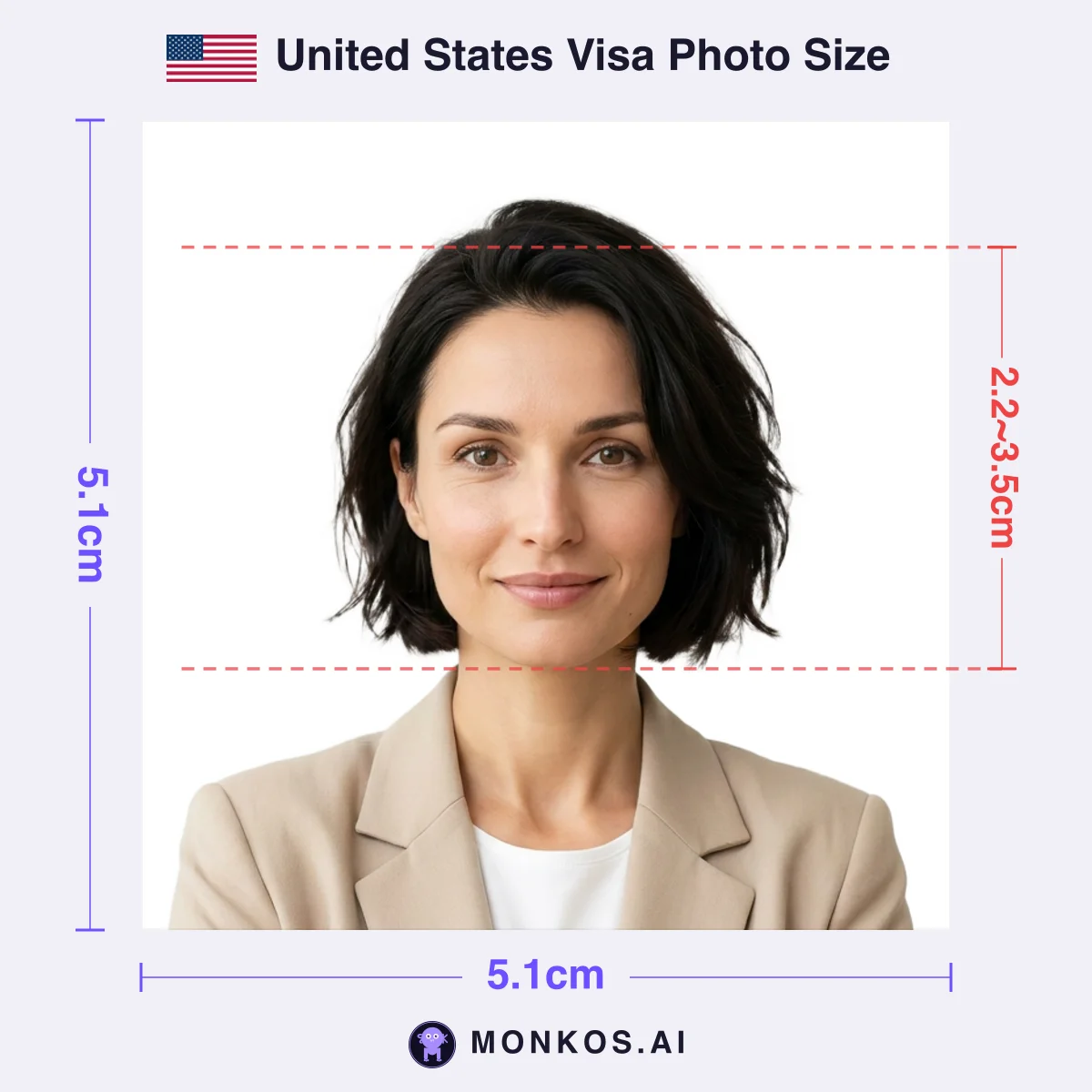
| Size | 2 × 2 inch (51 × 51mm) |
|---|---|
| Resolution | 600 × 600px |
| DPI | 300 or higher |
| Background | White |
| Head Height | 2.5-3.5cmRequired |
| Validity | taken within 6 months |
| File Spec | JPEG format, max 240KB, 600x600px min to 1200x1200px max, 24-bit color, sRGB |
- Follows 22 CFR 51 standard
- White background, frontal view, neutral expression
Restrictions
- Clothing
- daily clothing; no uniforms except religious clothing worn daily
- Expression
- neutral facial expression, both eyes open
- Glasses
- eyeglasses no longer allowed except rare medical circumstances with documentation; if medically approved, frames must not cover eyes, no glare
- Ears
- ears should be visible
- Face
- full-face view directly facing camera; forehead and eyebrows must be visible; no shadows obscuring features
- Headwear
- no hat or head covering unless worn daily for religious purpose; religious covering must not cast shadows on face
- Accessories
- no headphones or wireless hands-free devices; hearing devices allowed
- Uneven background
- Head tilt
- Wrong size
- Shadow detected
- Improper expression
Documents Accepting the Same Photo
1
Do Photo Specs Differ by Visa Type? One Standard for All
US visa photo requirements are identical across all visa categories — B1/B2, F-1, H-1B, J-1 and every other type: a 2×2-inch (51×51 mm) print, or a square digital image of 600×600 to 1200×1200 pixels.
The State Department publishes a single set of photo specifications; what changes is the submission channel, not the spec. Nonimmigrant applicants — tourists on B1/B2, students on F-1, workers on H-1B, exchange visitors on J-1 — upload one digital image inside the DS-160 online application (DS-1648 for A, G and NATO renewals in the US). Immigrant visa applicants filing the DS-260 instead bring two identical printed photos to their interview, and Diversity Visa entrants upload a digital image at entry, then bring two prints if selected. The channel dictates quantity and format — not the dimensions.
Some embassies and consulates additionally ask DS-160 applicants to bring one printed photo to the interview, and the State Department explicitly defers to each post's own instructions — so carrying a spare 2×2 print is a sensible hedge even after a successful upload. Prints must be on photo-quality paper, matte or glossy; black-and-white photos are not accepted.
DS-160 Digital Upload Specs and the DV Lottery Exception
A US visa digital photo for the DS-160 must be a square JPEG between 600×600 and 1200×1200 pixels and no larger than 240 kB — except for the DV lottery online entry, which requires exactly 600×600 pixels.
The State Department's full digital spec reads: square aspect ratio (height equals width), 600×600 px minimum, 1200×1200 px maximum, 24-bit color in the sRGB color space, JPEG format, 240 kB or less, with a compression ratio no higher than 20:1. If you scan an existing print, the original must measure 2×2 inches (51×51 mm) and be scanned at 300 pixels per inch (12 px/mm). The head — chin to top of head — must fill 50% to 69% of a digital image's height, equivalent to 1 to 1⅜ inches (25–35 mm) on a print.
The Diversity Visa program is the one place the range disappears: an online DV entry photo must be exactly 600×600 pixels, and the State Department's free photo tool crops to precisely that size. The tool is for cropping only — a State Department employee still makes the final call on whether your photo is acceptable.
If the DS-160 or DS-1648 confirmation page shows an 'X' where your photo should be, the upload failed: bring one compliant printed photo together with the confirmation page to the embassy or consulate where you apply. If your photo appears on the confirmation page, the upload succeeded and no separate print is normally required.
Eyeglasses Banned Since November 2016 — Medical Exceptions Only
Eyeglasses have been banned in US visa photos since November 1, 2016; the only exception is a medical reason — such as recent ocular surgery — documented by a statement signed by a medical professional.
The State Department treats this rule prominently enough to give it its own FAQ entry, effective date included. Even when glasses are accepted on medical grounds, three conditions apply: the frames must not cover the eyes, there must be no glare on the lenses, and no shadows or refraction from the glasses may obscure the eyes. The Department's own wording — 'rare circumstances' — signals how narrow the exception is.
Sunglasses and tinted lenses are stricter still. A US passport photo may permit tinted prescription lenses with a medical certificate, but for a US visa photo no dark or tinted lenses are allowed under any circumstances. It is one of the clearest points where visa rules outrank passport rules in strictness — applicants who prepared their photo to passport guidance should re-check before submitting.
US-Specific Rejection Triggers: No Retouching, Dress Rules, the 6-Month Clock
US visa photos must not be digitally enhanced or altered to change your appearance in any way — even removing red-eye with editing software is grounds for rejection, while using a camera's built-in red-eye reduction at capture is allowed.
The State Department draws the line between capture and post-processing: switching on red-eye reduction while shooting is fine; erasing red-eye afterward with an editing tool is not, and no digital enhancement that changes your appearance is permitted. Photos copied or scanned from driver's licenses or other official documents are rejected outright, as are magazine photos, low-quality vending-machine or mobile-phone shots, and full-length photographs. Self-taken photos are officially allowed, but the Department cautions that most webcams and mobile phones cannot deliver sufficient quality — what matters is sharpness that holds up at 600×600 pixels or more, with correct composition.
The dress rules are distinctively specific: uniforms, clothing that merely looks like a uniform, and camouflage attire are all barred, with daily-worn religious attire the sole exception. Hats and head coverings pass only if worn daily for religious purposes — and even then the full face must remain visible with no shadows cast on it. Headphones and wireless hands-free devices are not acceptable; hearing devices may be worn.
The validity rule is two-pronged: the photo must have been taken within 6 months of submitting the application and must reflect your current appearance. Significant facial surgery or trauma, adding or removing numerous or large facial piercings or tattoos, or substantial weight change triggers a new-photo request even inside the 6-month window. Growing a beard or coloring your hair generally does not. The target of the rule is appearance-altering edits — what matters is whether the photo still looks like you at the interview window; cropping to spec and getting the lighting right at capture time are not what the ban is about.
Infant and Child Photo Rules — Stricter Than a US Passport
In a US visa photo, every child — infants included — must have their eyes open and look straight at the camera; unlike US passport rules, which accept a baby's eyes not being entirely open, visa rules grant no such allowance.
The child must be the only person in the frame: not just no parent posing alongside, but no supporting parental hands or arms visible in the shot. The State Department itself suggests two techniques: lay the baby on a plain white or off-white sheet, which supports the head and supplies the background (watch for face shadows when shooting from above), or drape a car seat with a white sheet and photograph the child seated in it.
The eyes are where passport habits become a trap. US passport guidance states it is okay if a baby's eyes are not entirely open, but the visa photo FAQ answers the closed-eyes question with a flat no — the child's eyes must be open and looking straight ahead at the camera. That gap is exactly why reusing a passport-approved newborn photo for a visa application is risky.
On the other hand, a child under 16 whose appearance has changed through the normal aging process generally does not need to submit a new photo — though acceptance always remains at the discretion of the embassy or consulate where you apply.